Partner Login
  Customer Support

 Fibre Termination
  Wi-Fi Routers
  Wi-Fi Access Points
  Value-added Services
 Sága Wi-Fi 7 Routers
Designed for peak performance and easy refurbishment.
Find out more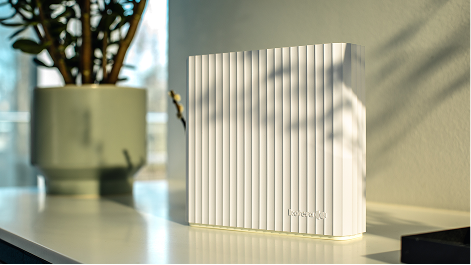

Customer Case · Fibia
Being best in class is something to strive for, especially in a competitive fiber market. It helps you retain and attract customers as well as boost your bottom line. That’s the experience at Denmark’s largest fiber company: Fibia.
The rapid pace in the fiber industry has caused intense competition in getting customers to connect to fiber. What used to be a market of the few is now a heavily packed battlefield of network operators and ISPs trying to outmatch each other on price, service, and speed.
That’s the experience of Brian Lønroth, SVP Marketing & Products at the Danish fiber network company Fibia, which provides fiber and internet to more than 250,000 customers:
— As the fiber market opens, competition is increasing, which means that the homogeneous fiber market as we know it is becoming more polarized and diverse. In a competitive market, ensuring good customer experiences from the beginning is very important, he says.
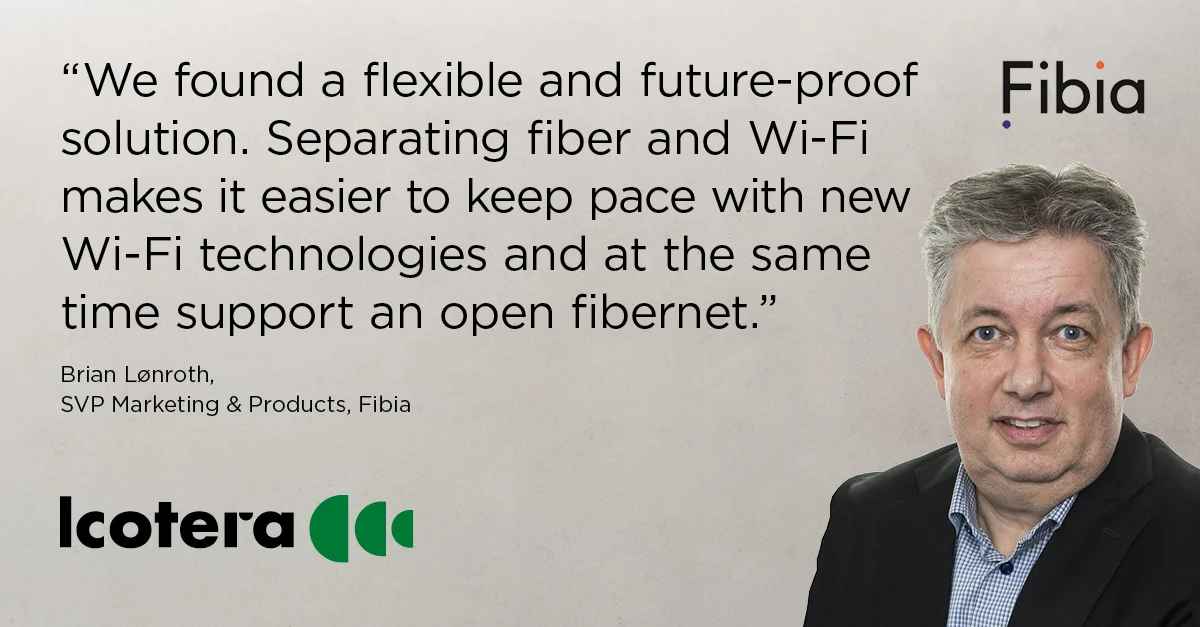
“We found a flexible solution that works now and in the future. By separating the boxes, it’s easier for us to keep up with the pace of Wi-Fi technologies and only change a smaller part when necessary and at the same time support an open fiber net.” Brian Lønroth, SVP Marketing & Products at Fibia
When your business is well known for delivering high-end internet solutions, an increasing number of support calls caused by poor in-home performance is no good for your business case at all. Nevertheless, this is what happened at Fibia a few years ago:
— We had customers calling and complaining about poor Wi-Fi coverage. And as the customer issues could rarely be solved over the phone, we had to send a technician to every address to try to fix things. Unforeseen truck rolls are bad from a financial perspective and for customer satisfaction. So, we had to come up with a solution to benefit both our business and our customers, Brian Lønroth says.
At that time, like many other internet service providers, Fibia delivered a one-box setup to their Wi-Fi customers. But in the wake of their challenges, Fibia shifted to a two-box solution based on products from Icotera, where fiber and Wi-Fi are separated into two boxes:
— In a one-box setup, the box is naturally placed where the fiber enters the home, which is often in a closet, behind a washing machine or in another metal-covered corner. This impedes the Wi-Fi signal. The poor Wi-Fi performance caused a lot of support calls from frustrated customers, and no matter how you look at it, that’s a bad start to a customer relation, Brian Lønroth says.
Fibia’s shift to a two-box setup has turned out to be profitable in several ways. Financially as well as relationally. As a high-end ISP, providing a premium product alongside a premium service is paramount.
For this reason, Fibia has decided to send a technician to all their new premium service customers to ensure optimal placement of the Wi-Fi unit:
— Our largest target group is not part of the tech savvy generation, and they have certain reservations when it comes to installations and electronic devices. For these people, an experienced technician is a way of ensuring the best possible customer experience from the beginning, which is very important to secure satisfied and loyal customers.
The technician service has become an integrated part of Fibia’s premium service because they believe in doing things right first time.
— You can’t avoid truck rolls completely, so you might as well find a profitable way to integrate them into your business. To us, a technician visit is worth the expense since it saves us both time and resources in the long run. In fact, it has turned out to be very cost-efficient, says Brian Lønroth.
In 2022, Fibia made a strategic decision to open their fiber infrastructure. At that time, they had already had the two-box solution from Icotera deployed for more than a year. With their two-box solution, they were geared up for their new strategy:
— We could have disabled the Wi-Fi in our existing boxes, but it wouldn’t have been as good a business case. With our current solution, we can combine good economics and good customer experiences, Brian Lønroth says.
Fibia has found their way to a more profitable business. Not only now, but also in the long run. Separating Wi-Fi and fiber is a futureproof solution ready to follow the development of Wi-Fi technology in the years to come.
— We’ve been able to find a flexible solution that works now and in the future. By separating the boxes, it’s easier for us to keep up with the pace of Wi-Fi technologies and only change a smaller part when necessary and at the same time support an open fibernet. Thus, we avoid creating a legacy base and we keep our installation base at a minimum, simply because we can make ongoing changes, Brian Lønroth concludes.


Wi-Fi 5
i4850 series

GPON
5900 series

Premium Wi-Fi Experience
Improved customer satisfaction

Future-proof Network
CPE solutions ready for expansion

Nordics
Danish Network Operator
Explore our high-performance fibre termination portfolio to see how we can support your growth.
Have questions or need guidance? Get in touch with our experts today


Interested in testing our product? We’ll send you a free sample so you can test its CPE performance in your lab. Send us a quick message and we’ll take care of the rest.